Data from CoinMarketCap & Alternative.me as of Dec 10, 2025. Verify before trading.

In a year where most Layer-1 blockchains are deep in the red, Bitcoin Cash has quietly emerged as the standout performer. While ETH is down, SOL struggles, and AVAX bleeds, BCH has climbed nearly 40%. That makes it the best-performing major L1 of 2025.
But here's what caught our attention: Freya has been tracking consistent whale accumulation throughout the year. The data shows net buying almost every month, with one particularly aggressive session where 60,000 BCH changed hands on Binance in a single hour.
This article breaks down what we're seeing: the whale activity, the key price levels, the upcoming ETF catalyst, and the risks you need to understand before making any moves.
Who this is for: Traders looking for data-driven altcoin opportunities beyond the usual BTC/ETH focus. We present the facts. You make the decisions.
Bitcoin Cash (BCH) was created in August 2017 as a hard fork of Bitcoin. The split happened because a group of developers believed Bitcoin should prioritize fast, cheap payments rather than solely focusing on being a store of value.
The key difference: BCH has larger block sizes (32MB vs Bitcoin's 1MB), enabling more transactions per block and lower fees. This makes it practical for everyday payments, which is something the original Bitcoin whitepaper envisioned but BTC moved away from.
Our market intelligence system flagged several interesting signals around BCH over the past week. Here's what stood out:
Freya detected net buying every month except February and November 2025. This is notable because it shows sustained accumulation rather than a one-time pump.
One specific session showed 60,000 BCH net buying on Binance in a single hour. At current prices, that's over $33 million in a short window. When big players move like this, we pay attention.
Analyst Crypto Koryo attributed BCH's outperformance to "cleaner supply dynamics": no token unlocks, no foundation treasury selling, and no VC overhang. When there's less forced selling, accumulation can actually move price.
No analysis is complete without understanding what can go wrong. Here's what you need to consider:
| Risk Factor | Level | Details |
|---|---|---|
| Three Consecutive Rejections | MEDIUM | Freya noted BCH faced three consecutive rejections at resistance. Sellers are clearly present at these levels. |
| RSI Overbought Territory | MEDIUM | After the recent surge to $620+, the RSI entered overbought territory. A pullback or consolidation is possible. |
| BTC Dependency | HIGH | If BTC breaks down hard, BCH will likely follow. The FOMC meeting this week is a key macro risk to watch. |
| ETF Approval Uncertainty | MEDIUM | Grayscale's BCH ETF filing is promising, but SEC approval is not guaranteed. Don't assume it's a done deal. |
Here's what the charts are showing:
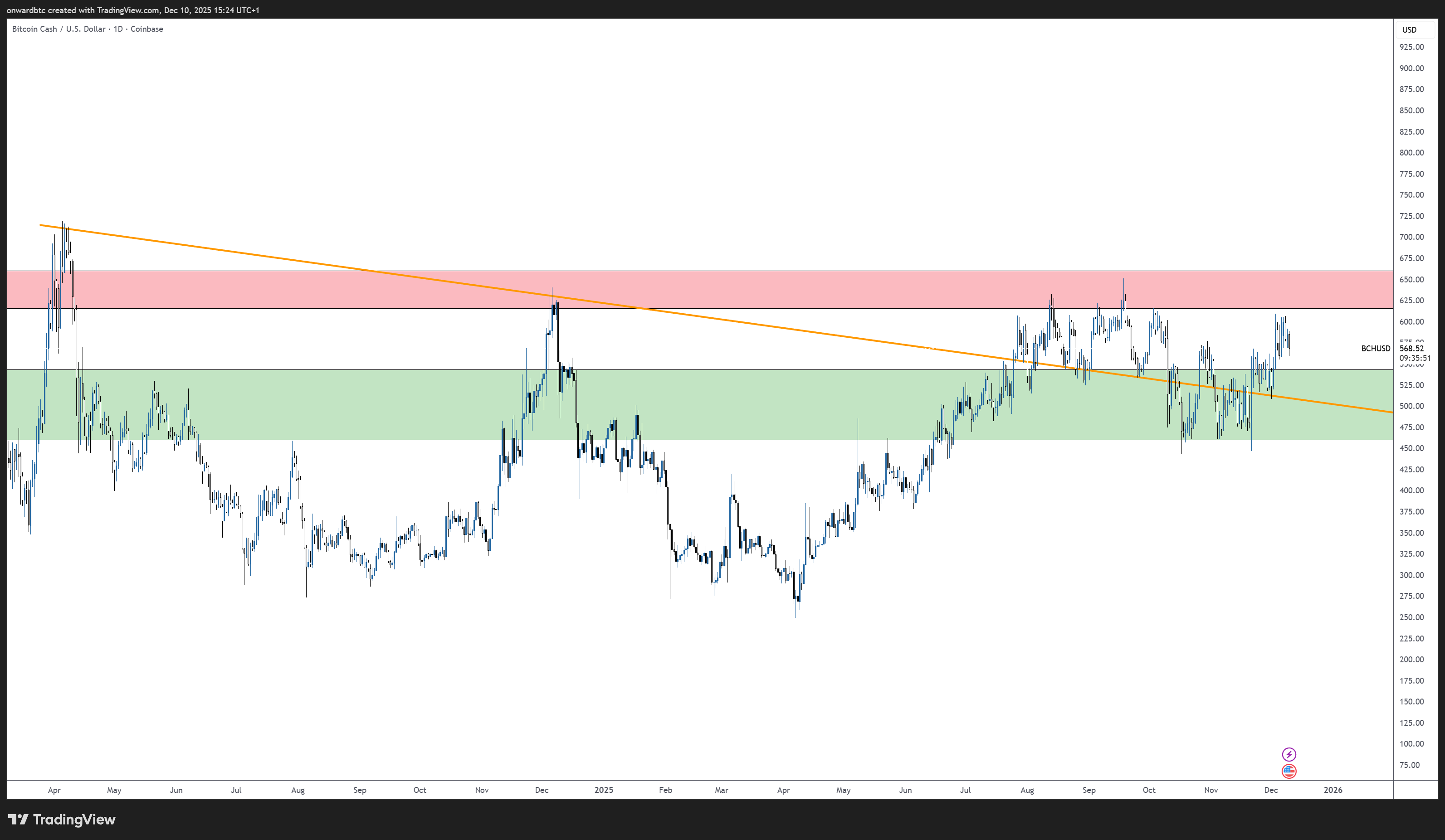
Analysts note that if BCH fails to break $540, a sell-off could continue toward $422 or even $300. The $620 level is described as BCH's "toughest technical test in 12 months." A breakout could trigger 60% upside, but failure risks a 50% collapse.
Grayscale submitted SEC filings to convert its Bitcoin Cash Trust ($214M in assets) into a spot ETF. If approved, this would be the first BCH ETF in the US, potentially driving significant institutional demand.
BCH completed the Velma hard fork in May 2025, introducing VM Limits and BigInt. This boosted smart contract and DeFi capabilities, positioning BCH to compete beyond just payments.
Watch the $615 and $640 sell walls. If BCH breaks through with volume, the $660 target becomes viable. Consider scaling in on pullbacks to the $541 support area. Set stops below $520 to protect against a breakdown.
The clean supply dynamics (no unlocks, no VC overhang) and potential ETF catalyst make BCH interesting for longer holds. Consider building a position on significant pullbacks toward the $450-$500 zone, with a 6-12 month outlook.
The identified sell walls at $615 and $640 provide clear rejection points for shorts. The $520-$541 support zone offers bounce plays. FOMC week will likely bring volatility. Size down and respect your stops.
Analysts attribute it to "cleaner supply dynamics." BCH has no token unlocks, no foundation treasury dumping, and no venture capital overhang. While other L1s face constant sell pressure from early investors unlocking tokens, BCH doesn't have this problem. All 21 million BCH will be mined through the same schedule as Bitcoin.
It would be the first spot BCH ETF in the United States, allowing institutional investors to gain exposure without directly holding the cryptocurrency. Based on Bitcoin ETF flows since January 2024, even a fraction of that interest could significantly impact BCH's much smaller market cap.
We don't give investment advice. What we can tell you: the data shows whale accumulation, clean supply dynamics, and potential ETF catalysts. It also shows overbought conditions, clear sell walls, and macro risk from FOMC. Make your own decision based on your risk tolerance and trading style.
Short-term pattern target is $660. Some analysts see potential for $700-$800 if momentum continues and the ETF narrative gains traction. However, if the $620 resistance holds, a pullback to $422 or lower is possible. The market is highly uncertain. Don't trust anyone who claims to know exactly where it's going.
Freya monitors order flow across major exchanges, tracks large wallet movements, analyzes liquidation clusters, and identifies patterns in buying/selling behavior. When significant net buying or selling occurs, Freya flags it in real-time so you can see what big players are doing.
Freya monitors markets 24/7 and delivers insights like these directly to your Telegram. No charts to decode. No confusion. Just professional intelligence.
Try Free for 30 DaysNo credit card required • Cancel anytime
This article is for informational purposes only and does not constitute financial advice. Cryptocurrency trading involves substantial risk of loss. Past performance does not guarantee future results. The price data, whale activity analysis, and technical levels presented are based on available information at time of publication and may change rapidly. Always do your own research and consider your financial situation before making investment decisions. Never invest more than you can afford to lose.