Data from CoinMarketCap. Verify current prices before trading.

Monero just pulled off one of the most dramatic moves of 2026. While most altcoins struggle to hold support levels, XMR exploded through resistance and hit new cycle highs above $700. The timing is no coincidence.
On January 7, the Electric Coin Company team announced their departure from Zcash following a governance dispute. Within days, capital rotated aggressively from ZEC into Monero. Then legendary trader Peter Brandt announced he bought XMR, comparing the setup to silver's historic breakout pattern.
This article breaks down what Freya detected, the key price levels to watch, and the risks you need to consider before taking a position.
Who this is for: Traders looking for privacy sector exposure, swing traders seeking volatility plays, and anyone who wants to understand why XMR is outperforming while getting banned.
Monero (XMR) is a privacy-focused cryptocurrency launched in 2014. Unlike Bitcoin where all transactions are publicly visible, Monero uses three technologies to make transactions untraceable by default.
Ring Signatures mix your transaction with others, hiding the sender. Stealth Addresses create one-time addresses for each transaction, hiding the recipient. RingCT hides the transaction amount from outside observers.
This makes XMR the gold standard for financial privacy. While Zcash offers optional privacy, Monero's privacy is mandatory on every transaction. This is why regulators target it, and why demand keeps growing despite delistings.
XMR surged over 60% in the past week and pushed above $700, marking a new cycle high. This is one of the strongest weekly performances among large cap cryptocurrencies in early 2026.
On January 7, the Electric Coin Company team departed Zcash after a governance dispute. This triggered immediate capital rotation from ZEC into XMR as traders sought stability in the privacy sector.
Legendary trader Peter Brandt publicly announced he bought XMR, comparing the chart setup to silver's historic breakout pattern. Volume surged significantly from December averages.
Resistance: $750 (psychological), $800 (round number), $1,000 (major target)
Support: $601 (breakout level), $560 (previous resistance), $480 (20-day MA)
| Risk Factor | Severity | Notes |
|---|---|---|
| RSI Overbought | MEDIUM | After 60%+ weekly move, pullback risk is elevated |
| Regulatory Crackdown | HIGH | DFSA just banned privacy tokens, more bans possible |
| Limited Exchange Access | HIGH | Delisted from Binance Feb 2024, fewer liquid venues |
| FOMO Driven Rally | MEDIUM | Sharp moves can reverse sharply, size accordingly |
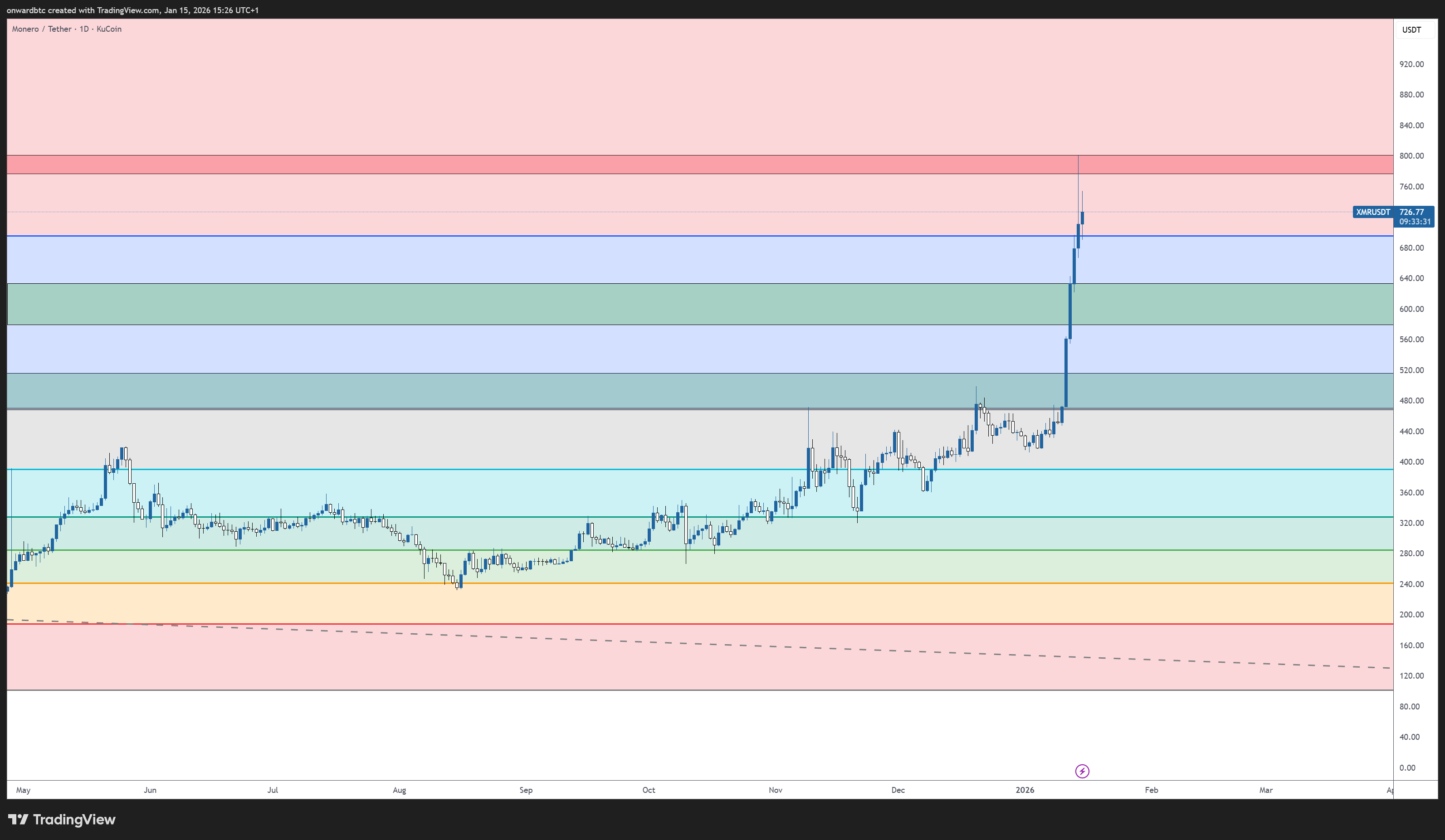
Click chart to view full size
XMR broke decisively above the $500 to $550 range that had capped price action for years. The move accelerated after the Zcash governance crisis, with volume confirming the breakout.
$750 - Psychological barrier
$800 - Round number resistance
$1,000 - Major psychological target
$601 - Breakout retest level
$560 - Previous resistance
$480 - 20-day moving average
Peter Brandt's comparison to silver's historic breakout is notable. Silver spent years consolidating before exploding higher. XMR shows similar characteristics: long base, sudden breakout, volume confirmation.
On January 7, the Electric Coin Company team announced their departure from Zcash following a governance dispute. The uncertainty pushed privacy-focused capital into Monero as the established, decentralized alternative with no single point of failure.
The DFSA prohibited privacy tokens for regulated activities on January 12. Counterintuitively, XMR hit cycle highs that same day. As global KYC requirements tighten through regulations like EU DAC8, demand for financial privacy increases.
Since Binance delisted XMR in February 2024, the token has risen multiples from those lows. This proves that despite reduced exchange access, organic demand for privacy remains strong. Those who held through the delisting are now being rewarded.
After a 60%+ weekly move, chasing is risky. Consider waiting for a retest of the $600 to $650 breakout zone before adding exposure. If $750 breaks with volume, next target is $800.
Scale into positions on pullbacks rather than buying the rip. Key accumulation zones: $560 to $600. Invalidation below $480 would suggest the breakout failed.
If you believe privacy demand will continue growing, consider DCA strategies rather than timing entries. The thesis here is not about short term price action but long term demand for financial privacy.
XMR's breakout comes at a pivotal moment for the privacy sector. The Zcash governance crisis created a catalyst, and capital is rotating into the established leader. Peter Brandt's comparison to silver suggests potential for a sustained move if the pattern plays out.
The risks are real: regulatory pressure, limited exchange access, and overbought conditions after a 60%+ weekly move. But for traders who understand the privacy thesis, XMR offers a compelling setup with clear levels to trade against.
Freya detected this XMR breakout as it happened. Get whale movements, sector rotations, and market intelligence delivered to your Telegram.
Try Free for 30 Days →This article is for informational purposes only and does not constitute financial advice. Cryptocurrency trading involves substantial risk of loss. Past performance does not guarantee future results. Monero faces significant regulatory risks including exchange delistings and potential bans. Always do your own research and consider your financial situation before making investment decisions. Never invest more than you can afford to lose.